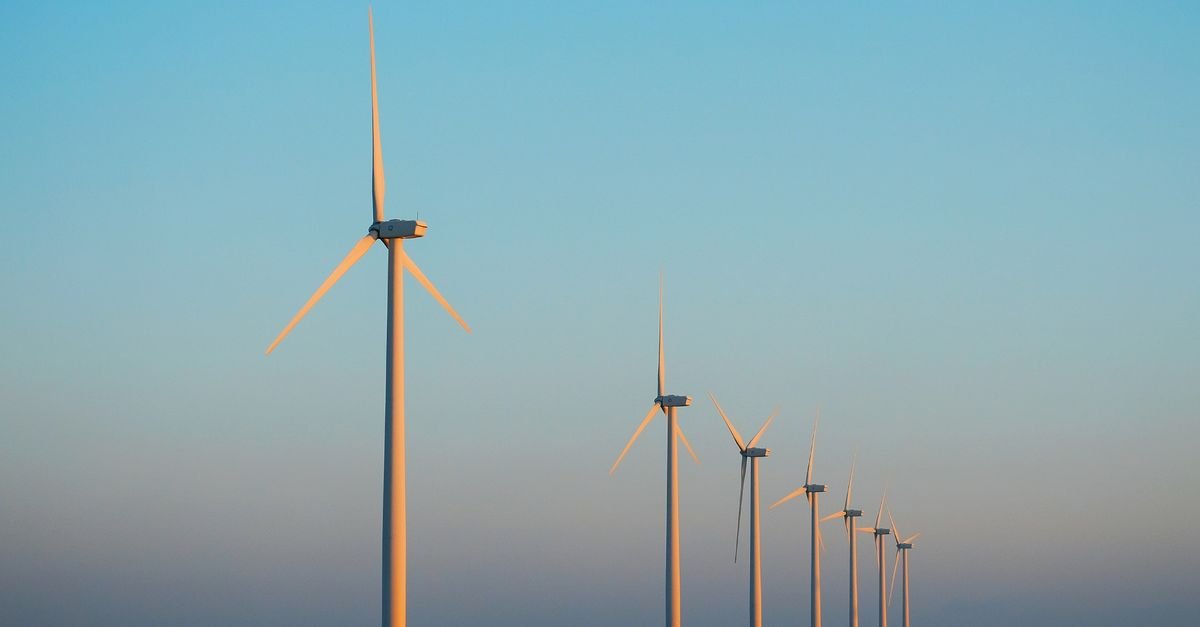
Offshore wind turbines operate in complex, dynamic environments where accurate structural models are essential for safety, design optimization, and condition monitoring. While high-fidelity multiphysics models are standard in the industry, they frequently diverge from actual measured behavior due to parameter uncertainties and unmodeled physical effects. Researchers addressed this challenge by developing a model updating framework applied to an instrumented General Electric Haliade 6-MW jacket-supported turbine.
The study employed surrogate modeling techniques—specifically artificial neural networks and polynomial regression functions—to replace computationally expensive OpenFAST simulations during the optimization process. By comparing modal parameters extracted from one month of field measurements (vibration sensors and supervisory control and data acquisition systems) against model predictions, the team iteratively updated the elastic modulus of the tower and substructure. This approach significantly reduced computational burden while maintaining accuracy.
Key findings revealed distinct performance characteristics across operational ranges. The fully coupled OpenFAST model provided superior physical consistency in the medium power band (0.5–4.5 MW), where aero-hydro-servo-elastic interactions heavily influence structural response. The simplified OpenSees framework proved more reliable at low and high power levels, where pitch control systems and aerodynamic stalling effects dominated structural dynamics, reducing the importance of coupled physics.
These insights have practical implications for offshore wind farm operations. Engineers can now select appropriate modeling tools based on turbine operating conditions, improving the accuracy of condition monitoring systems and remaining useful life predictions. Surrogate-based model updating also enables rapid incorporation of field data into design and assessment workflows, reducing the need for expensive full-scale simulations.
The research demonstrates how combining measurement data, optimization algorithms, and machine learning techniques can bridge the gap between theoretical models and real-world performance, ultimately enhancing safety and reliability of offshore wind infrastructure.