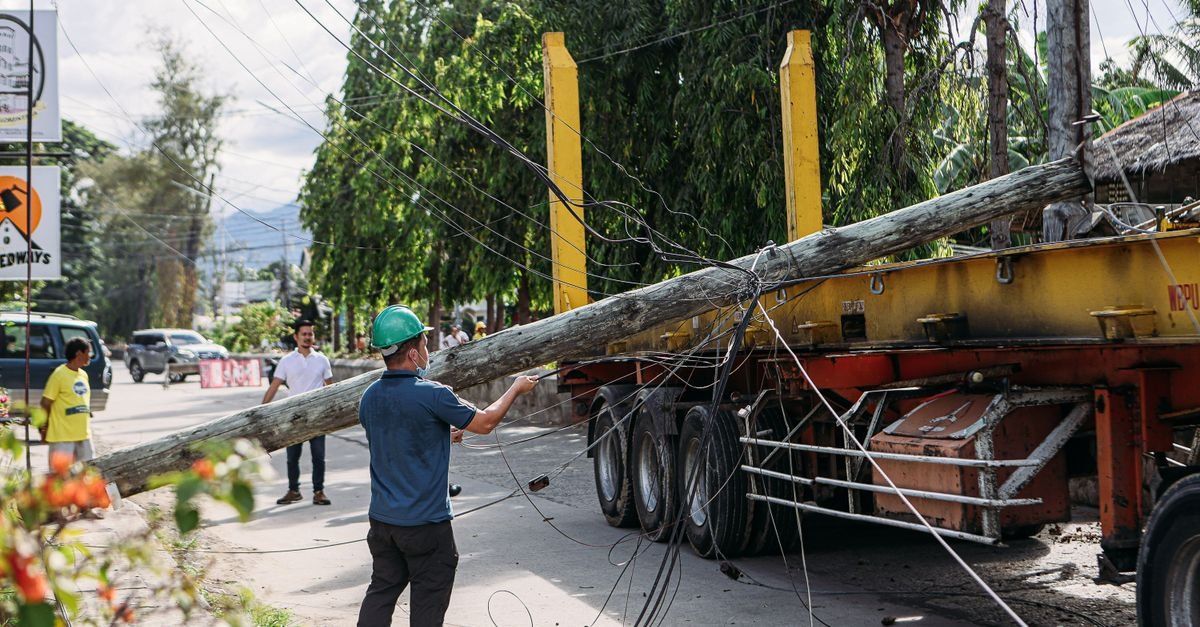
Power distribution utilities face a persistent challenge: how to restore service fairly and efficiently when outages occur across multiple locations simultaneously. A new research framework addresses this gap by integrating customer experience and fairness into restoration planning, departing from conventional approaches that treat outages as deterministic events affecting isolated network sections.
The proposed methodology recognizes that outage patterns are inherently stochastic—unpredictable in both location and timing. Rather than assuming worst-case scenarios, the framework incorporates failure probability distributions to guide resource allocation decisions. This probabilistic approach enables utilities to pre-position repair crews and plan restoration sequences that balance restoration duration across all affected areas, reducing the perception of unfair service among some customer groups.
The system operates through two coordinated mechanisms. First, a spatially distributed partitioning policy segments the distribution network into adaptive service zones, designed to equalize expected restoration times across regions. This ensures that customers in remote or historically neglected areas experience comparable service speed to those in central locations. Second, an adaptive dispatch algorithm dynamically routes repair crews toward active outages while maintaining fairness constraints, preventing any customer segment from bearing disproportionate restoration delays.
The framework employs Receding Horizon optimization, a control technique that repeatedly solves short-term restoration problems while accounting for future uncertainty. This enables real-time adaptation as new outages occur and crew availability changes, maintaining fairness principles even as conditions evolve.
Testing on modified 69-bus distribution networks under stochastic outage scenarios demonstrated the approach's effectiveness at reducing maximum restoration times and improving perceived equity. The scalable, distributed nature of the algorithm suits real-world deployment across utilities of varying sizes. By explicitly valuing fairness alongside efficiency, this framework addresses a growing concern in energy policy: ensuring that reliability improvements benefit all customers equitably, not just those in favorable geographic or demographic positions.